
UAE says Iranian missile threats were outside its borders as Gulf-wide attacks unfold
Iran launched missile and drone attacks on Qatar, Bahrain, Kuwait, Oman and Jordan, hours after fresh US strikes on Iranian targets over the Strait of Hormuz. The UAE issued a brief alert before saying the threats were outside its borders.

Key facts
- Iran launched missile and drone attacks against Qatar, Bahrain, Kuwait, Oman and Jordan, hours after the US carried out a third round of strikes on Iranian targets this week.
- The UAE issued a missile alert urging residents to shelter, before the Ministry of Defence said the threats detected were outside the country's borders and the situation remained stable.
- Qatar's Interior Ministry said three people, including a child, were wounded by shrapnel from intercepted fire.
- The US strikes followed an Iranian attack on a Cyprus-flagged container ship, the GFS Galaxy, in the Strait of Hormuz.
- Iran said the strait would remain closed "until further notice."
- Gulf states and Egypt condemned the attacks and called for a return to diplomacy.
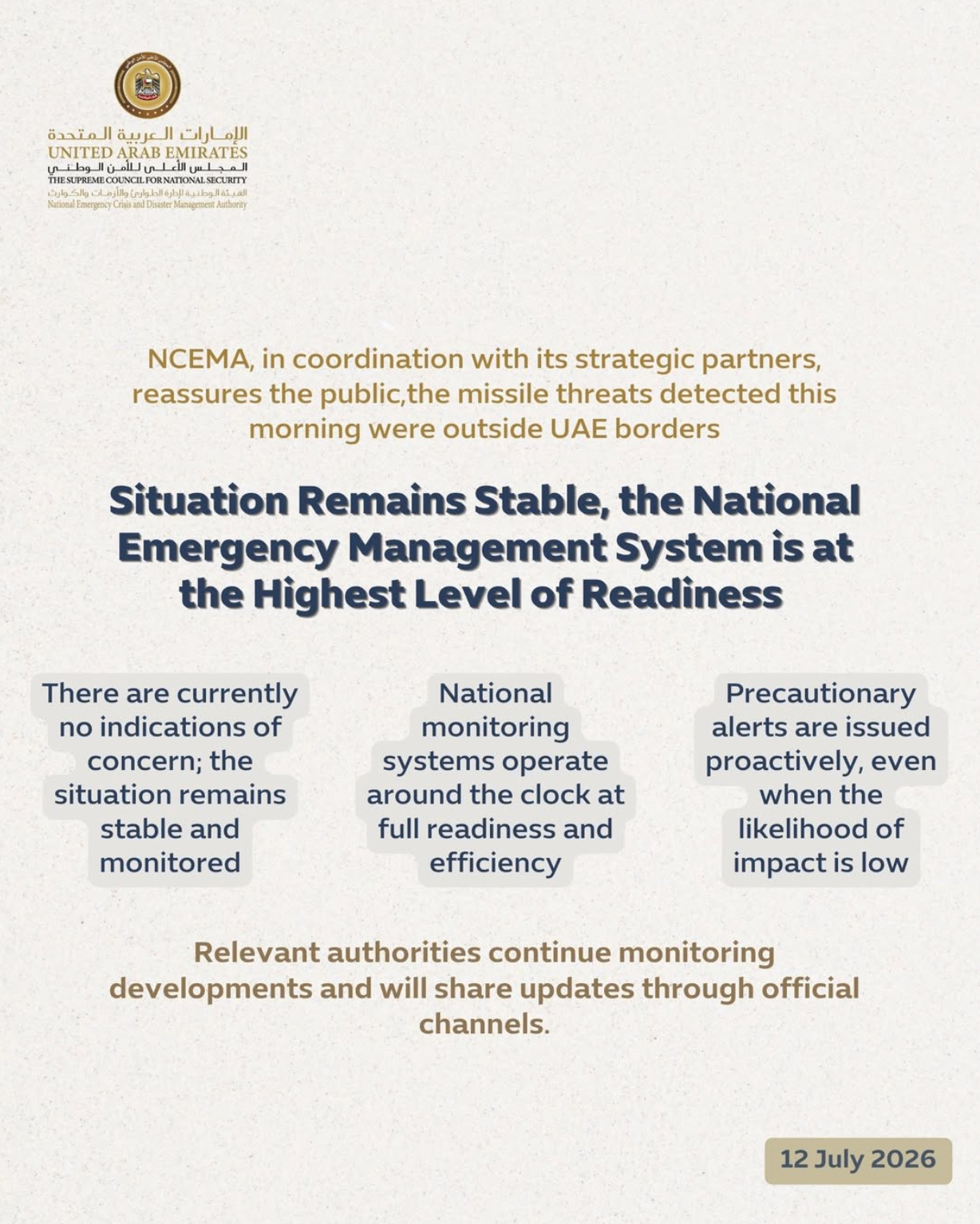
Dubai, UAE: The United Arab Emirates said missile threats detected in the region early on Sunday, July 12, were outside its borders and that the situation remained stable, after its Ministry of Defence and the National Emergency, Crisis and Disaster Management Authority (NCEMA) had earlier issued an alert urging residents to seek shelter.
The alert came as Iran launched missile and drone attacks against Qatar, Bahrain, Kuwait, Oman and Jordan, hours after the United States carried out a third round of strikes on Iranian targets this week.
The NCEMA in an updated post on social media, wrote: "The situation remains stable, with national systems maintaining the highest level of readiness. Please rely on official channels for updates."
Qatar's military said it intercepted incoming Iranian fire, with explosions heard over Doha. Qatar's Interior Ministry said three people, including a child, were wounded by falling shrapnel from the interception. Missile alerts also sounded in Bahrain, home to the US Navy's Fifth Fleet, while Kuwait's military said it was intercepting incoming fire. In Oman, a security source said drones had targeted sites in the Musandam governorate. In Jordan, three Iranian missiles fell early Sunday across several locations, with no casualties reported and only minor material damage.
Why the US struck Iran again
The US Central Command said it launched the strikes after Iran's Revolutionary Guard attacked the GFS Galaxy, a Cyprus-flagged container ship operated by a Dubai-based shipping manager, as it transited the Strait of Hormuz. The vessel caught fire and suffered significant engine-room damage, and its crew abandoned ship. One civilian crew member was reported missing, according to Centcom.
U.S. Central Command (CENTCOM) announced it has completed a third round of strikes this week against Iranian military targets in response to another attack on a commercial vessel in the Strait of Hormuz.
— OSINTdefender (@sentdefender) July 12, 2026
According to CENTCOM, approximately 140 military targets were struck during… pic.twitter.com/qyqOhYttD7
Iran's Revolutionary Guard said several vessels had ignored approved navigation routes through the strait and that one had been struck by a "warning shot" and brought to a stop, according to the AP.
Iran declared the Strait of Hormuz closed "until further notice" and warned it could target further US military facilities in the region if it faced additional attacks.
Diplomacy continues alongside the strikes
The escalation followed a meeting between Iran and Oman's foreign ministers on Saturday, where both sides agreed to keep discussing the strait "at the technical and political levels," according to Oman. Iran did not, however, offer any public guarantee that the waterway would remain open to all shipping, a key demand of the Trump administration.
Saudi Arabia condemned what it called repeated Iranian violations of the sovereignty of neighbouring states. The UAE, Qatar and Egypt also condemned the strikes and called for restraint, while regional mediators including Qatar, Oman and Pakistan continued efforts to revive the ceasefire.
How the crisis reached this point
Sunday's exchanges are the latest stage in a conflict that began on 28 February, when Iran's then Supreme Leader, Ayatollah Ali Khamenei, was killed in a joint US-Israeli air strike on his compound in Tehran, along with several family members. His son, Ayatollah Mojtaba Khamenei, was named his successor on 8 March with the backing of the Islamic Revolutionary Guard Corps, and has not appeared in public since the strike that killed his father.
The US and Iran signed a memorandum of understanding in mid-June, setting a 60-day ceasefire period to negotiate a permanent end to the war, according to Reuters and CNN. The agreement reopened the Strait of Hormuz to commercial shipping and eased some US sanctions on Iranian oil sales.
The truce came under repeated strain in the weeks that followed, with intermittent attacks on commercial vessels in the strait prompting limited retaliatory US strikes on several occasions, according to ABC News. Tensions escalated further after Ali Khamenei's week-long funeral, which concluded with his burial on 9 July at the Imam Reza Shrine in Mashhad.
At the close of the funeral, Mojtaba Khamenei issued his first public statement since taking office, vowing that Iran would avenge his father's death, in a message carried on Iranian state television, according to the Associated Press.
President Donald Trump declared the ceasefire "over" on 10 July, while confirming that talks with Iran would continue, in a post on Truth Social. Diplomatic contacts persisted alongside the military exchanges, including a meeting between Iran and Oman's foreign ministers on 11 July.



Comments ()