
Trump Says US Will Hit Iran 'Very Hard' Again and Threatens to Take Kharg Island; Iran Says Strait of Hormuz Closed, US Denies
Trump said the US will hit Iran "very hard" again and threatened to seize the Kharg Island oil terminal. Iran says the Strait of Hormuz is closed; the US denies it.
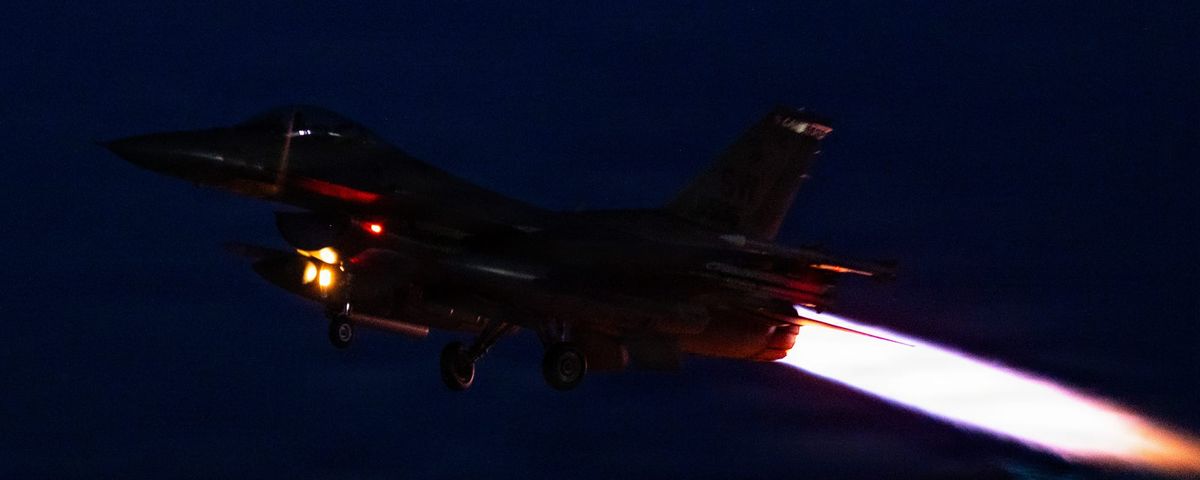
- President Donald Trump said the US would hit Iran "very hard" again and threatened to seize Iran's Kharg Island oil terminal.
- The United States carried out a second straight day of air strikes on Iran early on Thursday, according to US Central Command.
- Iran said it struck US forces in Kuwait, Bahrain and Jordan in response, according to its Revolutionary Guard.
- Iran said the Strait of Hormuz is closed to all ships.
- US Central Command said the strait is still open.India said three of its seafarers were killed after a US strike on a tanker off Oman, the third vessel with Indian crew hit this week.
- Qatar and Pakistan said mediation efforts to end the war continue.
What happened in the latest US-Iran strikes?
The United States launched a second straight day of air strikes on Iran early on Thursday, according to US Central Command. The command said the strikes hit military surveillance, communication systems and air defence sites, using precision munitions, and described the operation as "self-defence." It said the strikes ended about four hours after they began.
Iranian media reported explosions across southern Iran. Al Jazeera, citing Iranian outlets, said the areas named included Bandar Abbas, Minab, Sirik, Qeshm Island and Kish Island. Explosions were also reported in Karaj, near Tehran.
President Donald Trump told Fox News that US forces fired 49 Tomahawk missiles, the BBC and others reported. He said some struck as close as 40 miles (64km) from Tehran. Trump said Iranian officials had called him to ask him to stop. Iran rejected that account and said there had been no such contact.
What has Trump threatened next?
In a post on Truth Social, Trump said the US would hit Iran "very hard" again and would take Kharg Island and other oil infrastructure "in the not too distant future," the BBC reported. He said the US would assume total control of Iran's oil and gas markets, comparing the approach to Venezuela.
Speaking to Fox News soon after, Trump struck a more cautious tone, according to the BBC. He said his preference had been to take Kharg Island, but he questioned whether the US had "the stomach" for it and said he did not want to put troops on the ground. He also said the US had dropped $250m worth of bombs on Iran overnight.
Kharg Island, off Iran's coast, holds a major oil terminal seen as central to Iran's economy. The US struck the island on 13 March. Analysts cited by the BBC said any attempt to seize it would be difficult and would require a landing force.
Separately, Al Jazeera reported that US Treasury Secretary Scott Bessent threatened to use frozen Iranian funds to compensate US allies in the Gulf for damage caused by Iranian attacks.
How did Iran respond?
Iran's Islamic Revolutionary Guard Corps (IRGC) said it carried out two waves of strikes on US forces in the region, according to Iranian state media. It said it hit 18 targets. The named sites were US bases in Kuwait and Bahrain, including the US Navy's Fifth Fleet headquarters in Bahrain, and the Al-Azraq airbase in Jordan. The IRGC said it fired 12 ballistic missiles at Azraq for a second night and claimed to have destroyed US fighter jets there. The IRGC's claims have not been independently verified.
Jordan's military gave a different account, saying its air defences shot down 20 missiles fired from Iran towards the Azraq area, and that falling fragments caused no injuries and no damage.
Kuwait also said its air defences intercepted hostile targets. It briefly closed its airspace, then reopened it and resumed flights. Bahrain's Interior Ministry said an 11-year-old girl suffered minor injuries from falling debris after drones were intercepted, and that vehicles and homes were damaged in Manama and Hamad Town.
An Al Jazeera correspondent in Tehran reported that Iranian officials were signalling they would respond to any further escalation in a decisive way.
Is the Strait of Hormuz closed?
Iran said the Strait of Hormuz is closed to all vessels. Its top military command warned that any ship trying to pass would be targeted, and Iran's Persian Gulf Strait Authority said the closure would last "until further notice." An Al Jazeera correspondent said Iran had told vessels in the strait to wait.
US Central Command rejected this and said commercial ships were still moving in and out of the strait. The BBC reported that the US began a blockade of Iranian ports on 13 April. The strait is one of the world's most important shipping routes, with about 20 per cent of the world's oil and gas usually passing through it, according to the BBC.
Trump said the US military had helped about 200 commercial ships pass through the strait in what he called a secret mission, Al Jazeera reported. He claimed this had moved large volumes of oil out despite Iran's restrictions. Iran says the strait is completely closed. Neither account has been independently verified.
What is the impact on oil prices?
Oil prices swung during the day. The BBC reported that Brent crude reached just over $95 a barrel soon after 01:00 BST, then eased to under $92 by mid-morning. After Trump's threat to hit Iran and take its oil markets, Brent rose about $2 to $94.16 a barrel within minutes, before slipping back slightly, according to the BBC. Reports earlier in the week also said several liquefied natural gas tankers had left the strait and continued towards Asia.
What attacks have there been at sea?
India said three of its seafarers were killed after a US strike on a tanker off Oman, the Palau-flagged Settebello. India's foreign ministry summoned the US deputy chief of mission in New Delhi, Jason Meeks, and lodged a strong protest. The three crew were named as deck cadet Aditya Sharma, engine fitter Shivanand Chaurasia and chief engineer Patnala Suresh. BBC Verify reported that the tanker was last seen in satellite imagery on 8 June, about 80 miles (120km) off Sohar in Oman.
US Central Command said the Settebello was the eighth vessel it had disabled since the blockade began on 13 April, the BBC reported. It said 134 ships had been redirected after complying with US forces, and 42 humanitarian ships had been allowed through.
The US later confirmed a strike on a third vessel, the Guinea-Bissau-flagged Jalveer, accusing it of trying to move Iranian oil through the Gulf of Oman. A BBC weapons analyst reported that a US aircraft fired two Hellfire missiles into the ship's engine room. India's shipping ministry said the 20 Indian crew on board were safe and being evacuated. India said US forces had struck three ships this week, the Settebello, the Marivex and the Jalveer.
India's shipping ministry said 13 Indian-flagged vessels and more than 18,000 Indian sailors remained in the Gulf region, according to Al Jazeera and the BBC. Iran also said a US projectile hit an Iranian cargo barge in the Gulf of Oman, and that all five crew were rescued. The US did not comment on that report, which has not been independently verified.
BREAKING:
— Current Report (@Currentreport1) June 11, 2026
A vessel MT JALVEER crewed by Indians has been struck near Oman and suffered damage.
It remains unclear whether the ship was hit by Iran or US.
Meanwhile US strike on an Iraninan ghost tanker yesterday resulted in the death of 3 Indian crew members. pic.twitter.com/sYkwZkAeLL
What is the status of the ceasefire and talks?
Iran's Foreign Ministry said the new US strikes had made the ceasefire "practically meaningless." The ceasefire dates to 8 April 2026. The ministry called the strikes unlawful and warned of serious consequences.
The talks have not formally ended. The BBC reported that a Qatari negotiating team held meetings in Tehran overnight and then returned to Doha, citing a Qatari official who spoke to CBS News. Pakistan said its Interior Minister, Mohsin Naqvi, held meetings with senior Iranian leaders this week, and that it remained engaged in mediation alongside Qatar. A Pakistani spokesman said diplomacy and dialogue should guide both sides.
How are regional and world powers reacting?
Saudi Arabia's foreign ministry condemned Iran's attacks on Jordan, Bahrain and Kuwait and called for de-escalation and fresh talks mediated by Pakistan and Qatar, according to Al Jazeera. Qatar also condemned the attacks and urged a return to calm.
China said it was seriously concerned and that force would not resolve the underlying issues, the BBC reported. Russia urged both sides to return to talks and warned of harm to the world economy. Turkey's foreign minister called on the US and Iran to stop and resume negotiations. India called the repeated attacks on commercial vessels deeply worrying and urged de-escalation. Italy's Prime Minister, Giorgia Meloni, said the European Union should be ready to impose new sanctions on Iran if the crisis did not end, according to Reuters.
What is happening in Lebanon and the occupied West Bank?
Lebanese state media reported that an Israeli attack near a hospital in Tyre killed one person and injured 17, including hospital staff, according to Al Jazeera. Lebanon's National News Agency reported that earlier Israeli strikes in southern Lebanon killed at least 16 people. Israel said it was acting against Hezbollah infrastructure near Nabatieh and Tyre.
In the occupied West Bank, Israeli forces carried out further raids. Separately, the news outlet Axios reported that the Israeli cabinet was set to approve more than $350m to fund 61 new settlements. The United Nations considers Israeli settlements in the occupied West Bank illegal under international law. Israel disputes this.
What did the UN say?
UN Secretary-General António Guterres said the ceasefire was "more like a lesser-fire," in remarks to the Security Council and on X. He warned against the risk of lesser fire becoming full fire and urged all sides to work towards a diplomatic settlement, saying there should be no more attacks and no more excuses. He also called for an end to the expansion of Israeli settlements in the occupied West Bank.


Comments ()